


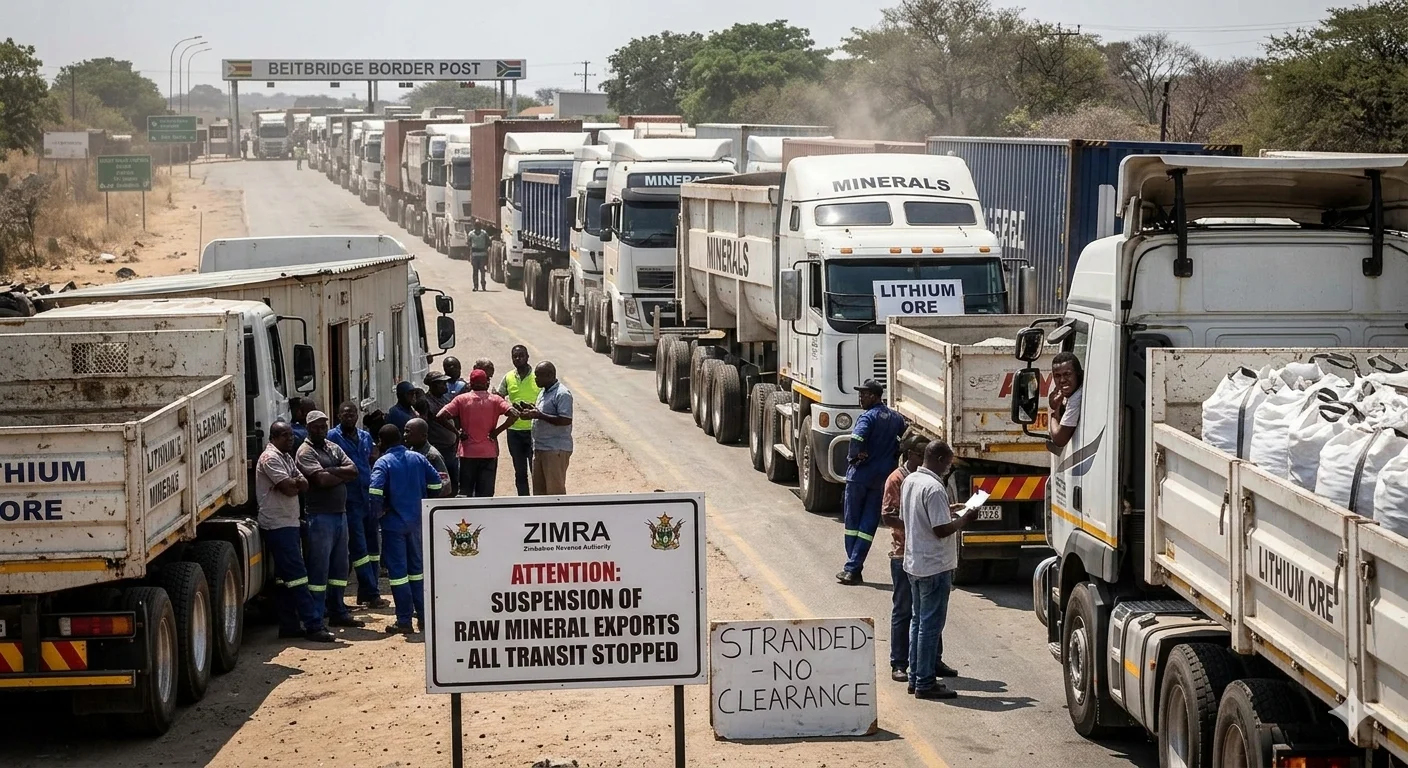
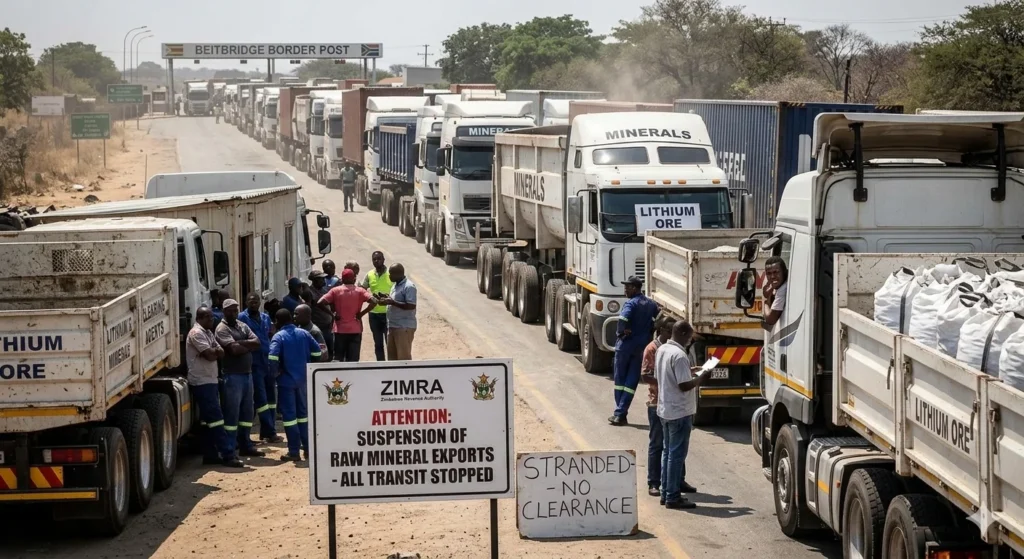
Zimbabwe’s shock decision to suspend exports of raw minerals and lithium concentrates has triggered chaos across its transport corridors, writes CHARLEEN CLARKE. It has left trucks stranded, operators furious and industry leaders accusing the government of committing a catastrophic political blunder.
Yesterday – in a blunt press statement – Polite Kambamura, Zimbabwe’s Minister of Mines and Mining Development, announced that his government had “suspended the export of all raw minerals and lithium concentrates with immediate effect until further notice”. In a move that stunned operators and regulators alike, the Minister added: “This suspension includes all minerals currently in transit.” He further instructed the Zimbabwe Revenue Authority (ZIMRA), the Minerals Marketing Corporation of Zimbabwe (MMCZ) and regulators “to observe the suspension without exception”.
Trucks stranded nationwide as confusion reigns
Within hours, the consequences were immediate and devastating. Trucks loaded with mineral exports ground to a halt across Zimbabwe, paralysing cross-border trade and leaving transporters facing mounting losses.
Mike Fitzmaurice, Vice President for Southern Africa at the African Union of Transportation and Logistics Organisations (UAOTL), is appalled at the ban. “It’s a typical political blunder. No clarity has been given as to exactly what the ban covers.”
According to Fitzmaurice, the fallout has been severe. “The ban has resulted in cross-border transporters’ trucks loaded with various minerals stranded all over the country – at mines, police stations and the Beitbridge Border Post. Trucks already at the border have not moved since the announcement was made yesterday. Clearing agents are refusing to process entries for fear of the consequences. ZIMRA was also left in the dark – not knowing what minerals were involved in the ban on exports,” he tells FOCUS.
Government defends ban as “national interest”
The Minister has insisted the measures are necessary, stating that his government remains committed to “ensuring transparency, in-country value addition and beneficiation, compliance, and accountability in the exportation of Zimbabwe’s mineral resources”.
He further warns: “Any mineral exports not supported by valid export permits and complete documentation shall be denied clearance.”
The press statement emphasised the policy shift, declaring that “only mining companies holding valid mining titles and approved beneficiation plants will be authorised to export minerals” and that “agents and third-party traders are not authorised to export minerals”.
The government’s objective is clear. Zimbabwe, which holds some of the largest lithium reserves in Africa, is attempting to force mining companies to process minerals locally rather than exporting raw material, particularly lithium. Lithium is essential for electric vehicles, battery storage and renewable energy systems, and Zimbabwe is determined to capture more value from its vast reserves.
UAOTL slams “total disregard” for transport sector
For transport operators on the ground, however, the damage has already been done. Fitzmaurice describes the government’s handling of the announcement as reckless and deeply damaging to the transport sector.
“It is totally unacceptable that transporters, exporters and border authorities were kept in the dark about the announcement. It is a typical case of blatant disregard for trade facilitation by the Zimbabwe government, and it is not the first time this has happened,” he tells FOCUS.
Fitzmaurice adds that attempts to obtain clarity from the authorities have been met with silence. “I have tried phoning the Ministry of Mines and Mining Development several times today – but no one answers the phone. I have tried emailing as well – with no joy.”
UAOTL says the lack of communication has compounded an already volatile situation, leaving operators exposed to severe financial risk.
Strategic lithium push comes at a steep cost
Behind the chaos lies a broader strategic shift by Zimbabwe’s government. The country has watched billions of dollars’ worth of raw minerals leave its borders with little domestic value added. By banning raw exports, the government hopes to force investment in local beneficiation plants, creating jobs and retaining more wealth inside the country.
But, while the long-term policy objective may be economic transformation, its execution has sent shockwaves through the transport sector.
“Hundreds of trucks remain immobilised, contracts are in jeopardy and operators face severe financial losses as delays mount,” reports Fitzmaurice.
Zimbabwe risks losing its position as regional transit hub
The crisis threatens to further weaken Zimbabwe’s position as a regional transit hub, a trend already underway after previous policy missteps.
Fitzmaurice pointed to last year’s controversial fuel transit tariff, introduced in an attempt to curb smuggling, which drove tanker operators away from Zimbabwe permanently. “The anti-smuggling measures have seen tanker operators move away from Zimbabwe permanently and, despite the duty tariffs on fuel having been reversed, truck volumes through Kazungula continue to increase dramatically from around 180 trucks per day northbound to 400 trucks per day,” he notes.
Fitzmaurice warns that the latest disruption could accelerate the exodus. “With the Kazungula border now operating 24 hours, this will see more and more transporters move away from Zimbabwe as a transit route.”
Industry confidence shattered as uncertainty deepens
For transporters already reeling from rising costs, regulatory uncertainty and regional competition, the latest ban has shattered confidence.
Hundreds of trucks remain stranded, cargo immobilised, contracts jeopardised and operators left in limbo.
Until clarity emerges, the damage continues to mount.
For many in the transport sector, the message is stark. “Zimbabwe’s latest attempt to reshape its mining industry may prove economically rational in the long term, but its execution has delivered immediate chaos, crippling the very logistics networks that sustain regional trade,” concludes Fitzmaurice.